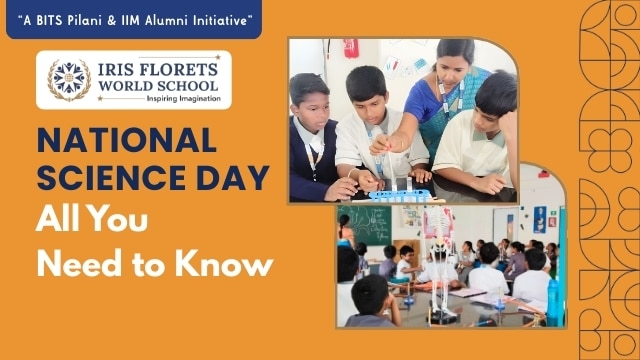
One observation, one question, and one moment of curiosity placed India on the global scientific map. National Science Day reminds us that great discoveries do not begin in textbooks; they begin with a curious mind willing to look closer.
What Is National Science Day?
National Science Day is celebrated across India every year on 28th February. This day marks a historic moment in Indian science, the discovery of the Raman Effect by the renowned Indian physicist C. V. Raman in 1928.
In 1986, the Government of India officially declared 28th February as National Science Day. Since then, schools, colleges, and scientific institutions have observed the day through science exhibitions, quizzes, experiments, seminars, and interactive activities.
The purpose of National Science Day goes beyond remembering a discovery. It is meant to encourage students to think scientifically, to observe closely, ask meaningful questions, and understand how science shapes the world around them. It reminds us that great ideas often begin with simple curiosity.
What Is the Raman Effect?
Light may appear simple, but it behaves in fascinating ways. The Raman Effect explains what happens when light passes through a substance and interacts with its particles.
When a beam of light travels through materials such as water, air, or glass, most of the light continues unchanged. However, a very small part of the light scatters and undergoes a slight change in energy. This change leads to a difference in the light’s wavelength or colour. This phenomenon is known as the Raman Effect.
To understand this simply, imagine shining a torch into a clear liquid. While most of the light passes straight through, a tiny portion changes because it interacts with the molecules inside the liquid. By studying this change, scientists can learn about the structure and composition of substances.
This discovery became a powerful scientific tool. Today, the Raman Effect is used in chemistry, physics, medicine, material science, and even space research. It helps scientists identify unknown materials and study substances without damaging them.
For this remarkable contribution, C. V. Raman became the first Indian scientist to receive the Nobel Prize in Physics in 1930, bringing global recognition to Indian science.
About C. V. Raman
Sir Chandrasekhara Venkata Raman was born on 7th November 1888 in Tamil Nadu, India. From an early age, he showed a deep interest in learning and scientific exploration. He was an exceptional student and completed his higher education at a remarkably young age.
What makes Raman’s journey truly inspiring is that much of his groundbreaking research was conducted in India, at a time when advanced scientific facilities were limited. His work proved that world-class scientific research could emerge from Indian institutions.
Raman was deeply observant of nature. During a sea voyage, he noticed the striking blue colour of the ocean and questioned the commonly accepted explanations. Instead of accepting simple answers, he chose to investigate further. This habit of observation and inquiry eventually led to the discovery of the Raman Effect.
His life teaches an important lesson: science does not begin in expensive laboratories alone. It begins with curiosity, careful observation, and the courage to question the ordinary.
Why Is National Science Day Celebrated?
National Science Day is celebrated to honour the contributions of Indian scientists and to highlight the importance of science in everyday life.
Science helps us understand natural phenomena, from the changing colours of the sky to the formation of rain. It explains how medicines work, how technology connects people, and how innovation improves quality of life. By celebrating this day, we recognise the role of science in shaping modern society.
Another key purpose of National Science Day is to inspire students. Learning about scientists like C. V. Raman helps young minds realise that great discoveries are not limited by geography or background. With curiosity, discipline, and effort, students too can contribute to the future of science and technology.
The day also promotes critical thinking. Scientific thinking encourages students to ask “why” and “how,” test ideas, and learn from experiments. These skills are valuable not only in academics, but in everyday decision-making and problem-solving.
The History of National Science Day
The journey of National Science Day began on 28th February 1928, when C. V. Raman announced his discovery of the Raman Effect. The importance of this work soon gained international recognition.
In 1986, the National Council for Science and Technology Communication (NCSTC) proposed that this historic date be observed as National Science Day. The Government of India accepted the proposal, and the first official celebration was held in 1987.
Since then, National Science Day has been celebrated annually with a specific theme focusing on key scientific issues such as innovation, sustainable development, and technology for social progress. These themes help students understand how science addresses real-world challenges.
Across the country, schools organise science fairs, project exhibitions, and hands-on experiments. Such activities encourage students to explore concepts beyond textbooks and experience the joy of learning through discovery.
Inspiring Young Minds Through Science
National Science Day is not only about celebrating past achievements, it is about shaping the future.
Every scientific discovery begins with a question. When students learn to observe carefully and think critically, they take their first step toward becoming innovators, researchers, engineers, and problem-solvers. India’s scientific legacy shows that curiosity and perseverance can lead to global impact.
As we celebrate National Science Day each year, we celebrate the courage to question, the patience to experiment, and the determination to learn. Science is present in every moment of our lives, and the next great discovery may begin with a curious thought in a young mind today.